

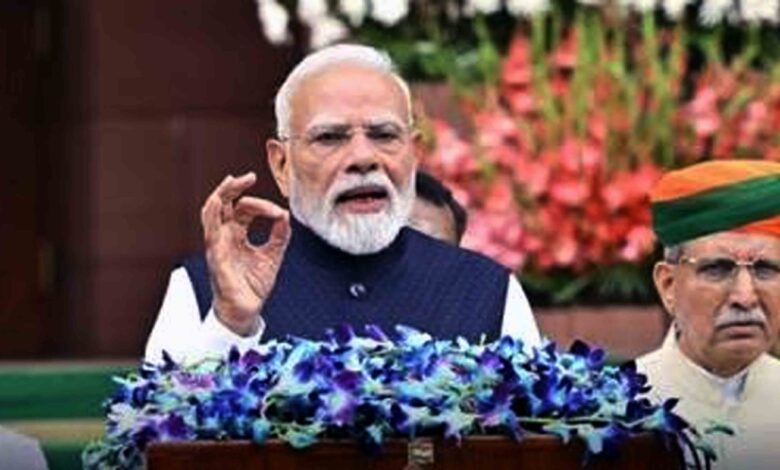
The Prime Minister’s message in ‘Mann Ki Baat’ is clear: India is no longer merely a guardian of its borders but is also becoming a creator of its own defence technologies. Addressing the nation in the 136th episode of his monthly radio programme ‘Mann Ki Baat’, Prime Minister Narendra Modi outlined a significant strategic vision regarding India’s defence capabilities and self-reliance.
He emphasized that a nation’s sovereignty is not secured solely by the indomitable courage of its soldiers; the presence of state-of-the-art indigenous technology to bolster that courage is equally essential. The Prime Minister’s specific mention of INS Mahendragiri, the Pinaka rocket system, and the Kusha missile defence project stands as living proof that India is shedding its old image as a nation dependent on imports in the defence manufacturing sector and is now establishing itself as a self-reliant and technology-empowered nation.
For decades, India remained at the top of the list of the world’s largest defence importers. Our reliance on foreign weaponry and spare parts during times of war or tension posed a major strategic challenge. However, in recent years, a radical shift has occurred in defence policy under the ‘Make in India’ and ‘Atmanirbhar Bharat’ (Self-Reliant India) initiatives. Today, the situation is such that India is not only meeting the requirements of its armed forces domestically but is also exporting various defence systems.
The Prime Minister’s address in ‘Mann Ki Baat’ was not merely a recounting of achievements; it was a declaration of India’s evolving geopolitical capability and strategic resolve on the global stage. The induction of INS Mahendragiri into the Indian Navy marks a new milestone in the country’s naval strength and shipbuilding capabilities. This seventh stealth frigate under Project 17A has been designed indigenously by the Indian Navy’s Directorate of Naval Design, and a significant portion of it has been constructed using indigenous materials and equipment. In light of evolving security challenges in the Indo-Pacific region and the need to safeguard maritime trade routes, India has a critical requirement for a robust navy.
Warships like *Mahendragiri* demonstrate that Indian shipyards are now fully capable of constructing world-class stealth warships. This not only enhances the Navy’s strike capabilities but also accelerates the growth of a vast domestic supply chain within the maritime defense sector. Similarly, the Pinaka multi-barrel rocket launcher system has become the backbone of the Indian Army’s artillery. Developed by the Defence Research and Development Organisation (DRDO), the Pinaka system has proven that India is on par with any developed nation in the manufacture of precision-strike rocket weaponry.
Its key attributes include high accuracy, rapid response time, and the capacity to inflict massive destruction. The Pinaka is no longer limited to the Indian Army; demand for it has risen in the international market, and India is now exporting the system. This serves as proof that Indian defense technology is meeting world-class standards. The Prime Minister’s mention of ‘Project Kusha’ highlights a historic step towards developing an indigenous long-range air defense system.
Under Project Kusha, India is creating a state-of-the-art air defense system capable of destroying enemy fighter jets, drones, cruise missiles, and ballistic missiles in mid-air at ranges of hundreds of kilometers. In today’s modern battlefield, where drone and missile strikes have become primary modes of warfare, an indigenous air defense system like Kusha will provide an impenetrable protective shield for India’s airspace. Eliminating reliance on foreign air defense systems will not only save billions of dollars in foreign exchange but also remove the risk of depending on another nation’s supply terms during emergencies.
The impact of self-reliance in the defense sector extends beyond border security, offering significant socio-economic benefits as well; the domestic production of defense equipment fosters the growth of an entire industrial ecosystem. This ecosystem comprises research and development institutes, Micro, Small, and Medium Enterprises (MSMEs), private sector defense companies, and tech startups. The defense corridors being developed across the country are creating new opportunities for high-level technical employment for the youth. However, this journey towards self-reliance is far from over.
There is a need to further increase budget allocations for defense research so that we do not merely manufacture existing technologies but also lead the world in future technologies such as Artificial Intelligence, quantum computing, cyber defense, and autonomous drone systems. Furthermore, continuous attention must be paid to quality control, maintaining smooth supply chains, and streamlining processes in defense production.
Synergy between the public and private sectors needs to be further enhanced to prevent unnecessary time and cost overruns in defense projects. Prime Minister Narendra Modi’s message in ‘Mann Ki Baat’ reflects India’s new defense culture. When the indomitable valor of the Indian Armed Forces combines with the technical prowess of the nation’s scientists, the country becomes invincible. INS Mahendragiri, Pinaka, and the Kusha missile system are tangible proof that India is no longer a nation dependent on others in the defense sector; instead, it is weaving the very fabric of its own security.