Mayors From Across The Country Arrive in Chandigarh
Administrator Outlines The Way To Work; Advice Given To Step Out Into The City At 5 AM

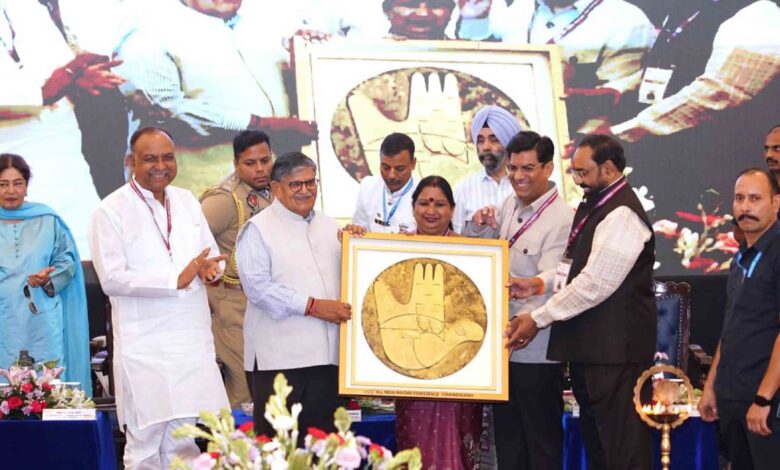
A mayor’s job is not merely to sit in the office and receive reports from officials. They should wake up at 5, 6, or 7 AM and visit the city’s streets, markets, and parks without being accompanied by any official.
They should observe whether sanitation workers are on the job, check the condition of roads and drains, and identify the problems the public is facing. The more they move among the public, the more work they will find to do. UT Administrator Gulab Chand Kataria offered this advice to mayors from across the country attending the 118th All India Mayors’ Council Conference.
Kataria stated that public representatives must connect directly with the people. Instead of turning public hearings into mere formalities, they should listen to the grievances of as many people as possible. Rather than spending time hosting VIPs for refreshments, it is better to spare two minutes to listen to a common citizen and find a way to resolve their issue.
He noted that about 80 percent of people’s problems at the local level are related to municipalities and panchayats. If local bodies resolve these issues, public satisfaction levels could rise significantly.
Daily Evening Review Of Online Complaints
He suggested to the mayors that in today’s times, every public complaint can be registered online. Therefore, a review should be conducted every evening with responsible officials to assess how many complaints regarding water, electricity, sanitation, parks, and other services were received and how many were resolved.
He remarked that a street light remaining broken for four months indicates a systemic failure. Once a complaint is received, accountability for its resolution must be fixed.
Employees Are Colleagues, Not Servants
Kataria stated that public representatives should view employees as colleagues rather than servants. Employees will discharge their responsibilities more effectively if work is extracted through mutual respect.
Punishing someone for every mistake does not necessarily lead to improvement. They should be made to realize their mistake and given a chance to rectify it. He stated that public representatives must firmly refuse to act against the rules, regardless of the pressure exerted on them.
Exercise Sensitivity When Imposing Fines On The Poor
While emphasizing the need to take action against those who litter the streets, he noted that a fine of even ₹50 can be a significant amount for a poor person. Therefore, financial circumstances should be considered when formulating fine structures. The objective should not merely be to collect money, but to change people’s habits.
Mayors From Other Cities Should Point Out Shortcomings
Speaking on the objectives of the All India Mayors’ Council, Kataria said that mayors from different cities should not only learn from each other’s best practices but also draw attention to shortcomings.
He urged visiting mayors not to leave after seeing only the positive aspects of Chandigarh but to also provide written feedback on any deficiencies they observed. This would help in improving the city.
Protection Of Trees Is Also Essential
Regarding the environment, he stated that merely planting saplings is not enough; protecting and regularly monitoring the planted saplings is crucial. If planting is done during the right season and the public is involved in the campaign, the chances of the saplings’ survival increase significantly. Citing the example of old trees, he remarked that trees are the earth’s treasure and must be protected for future generations.
Unnecessary Recruitment Increases The Burden On Civic Bodies
Kataria also highlighted the need to provide adequate powers and budgets to municipal bodies. He noted that responsibilities such as roads, drainage, electricity, and sanitation fall under the purview of local bodies; therefore, they must be provided with the necessary resources.
At the same time, there is a need to curb unnecessary recruitments. Additional appointments made for political or personal gain place a burden on the civic body’s budget, and ultimately, the public bears the consequences.
He remarked that while the tenure of a mayor or councilor lasts only a few years, their conduct and work among the public are remembered for a long time. Along with development work, qualities such as proper conduct, simplicity, honesty, and helping the needy define the true identity of a public representative.